The Rehab Optimization Cycle (ROC)
At its core, the ROC is a learning-health-system model built specifically for rehab departments. It is a continuous engine for practice improvement: collect what you already document, structure it well, discover what it's telling you, and feed that back into practice — on repeat, with a partner community around it rather than in isolation.
We meet your organization exactly where it is.
Each ROC phase represents a targeted, standalone consulting service. You can plug into the exact solutions you need to drive high-value rehabilitation, without a massive, restrictive contract.
The Rehab Optimization Cycle (ROC) Model
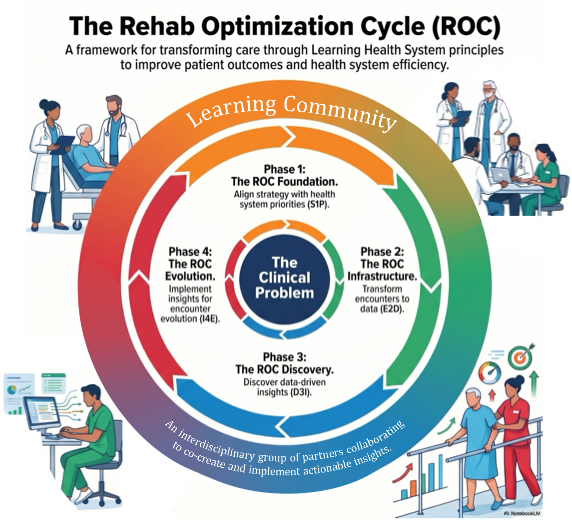
Our proprietary 4-Phase framework operates as a closed loop. Traditional academic clinical research takes years to trickle down to clinical practice. By contrast, RSC LLC embeds natively as a partner to help you harvest local clinical encounters, build the necessary socio-technical infrastructure, analyze bottlenecks, and immediately translate those discoveries into bed-side care modifications.
- Strategy aligned to organizational priorities (S1P)
- EHR native data strategy configuration (E2D)
- Internal bottleneck & variance analysis reports (D3I)
- Sustainable practice changes & Value ROI audits (I4E)
Leadership Alignment & Problem Prioritization
Align Strategy with Health System Priorities
As healthcare rapidly shifts toward value-based payment models, traditional rehabilitation frameworks often leave organizations struggling to capture and demonstrate their true impact. Because rehabilitation has historically functioned as somewhat of a "black box," it can be incredibly difficult to isolate specific systemic bottlenecks and definitively prove the value your clinicians provide to the broader health system.
We help you identify and target the complex clinical problems that matter most. As a partner, we help you translate broad challenges into specific, answerable questions that align with both executive priorities and frontline clinician pain points. By blueprinting a targeted Learning Health System around these prioritized questions, we help you assess your "Status Quo Risk" and build a compelling, unified business case for practice change.
ROC Infrastructure
Engineering a Data and Human Framework
Facilities often have an abundance of raw documentation but lack reliable, usable data to measure standard outcomes or performance. Even when data systems are in place, a lack of aligned incentives and clinical engagement often turns data collection into a frustrating compliance burden rather than a tool for practice evolution.
To transform Encounters to Data (E2D), we help you engineer a true socio-technical infrastructure that aligns your people, policies, and processes alongside existing technology. We design strategies to identify optimal existing measures and consult on leveraging current EHR platforms to extract "computable" data without adding workflow burdens. Crucially, we build the "Human Element"—structuring interdisciplinary Learning Communities that foster staff engagement, set clear expectations, and maintain data fidelity over time.
ROC Discovery
Discover Data-Driven Insights
Even health systems with standardized data collection often find that clinical outcomes and utilization metrics remain trapped in static reports. Without specialized analysis, organizations remain blind to workflow bottlenecks, high-cost post-acute leaks, and clinical practice variations that quietly erode operating margins.
We act as your embedded health services research partner, translating structured clinical databases into actionable intelligence. We formulate key operational questions around your specific care paths, execute rigorous bottleneck analyses, perform clinical practice variation audits, and compare your system-level metrics against external evidence-based guidelines to identify where clinical value and efficiency are leaking.
ROC Evolution
Implement Insights for Encounter Evolution
The path from an academic insight to frontline practice is notoriously slow, often taking years to implement. Many well-intentioned practice redesigns fail during execution because they disrupt workflows, overwhelm clinical staff, or fail to prove system-level return on investment (ROI).
We operationalize implementation science to redesign care at the bedside. Rather than generic guidelines, we engineer context-fit care models embedded natively into your existing clinical workflows. We provide structured implementation coaching to the "doers," evaluate practice fidelity, and mathematically calculate your Value-Based ROI (such as hospital capacity value and discharge cost avoidance) to close the learning loop and prove sustainable success.
Unbundled & Modular Consulting Model
Hospital administrators face highly specific operational pain points. Our "a la carte" structure allows you to plug into exactly what your organization requires—whether you need leadership alignment blueprinting in Phase 1, EHR data extraction strategies in Phase 2, bottleneck discovery in Phase 3, or bedside implementation coaching in Phase 4.
PT-PENCIL Integration
Transition your acute physical therapy department from subjective, highly variable prioritization to precision clinical triage. We integrate our validated decision support tool directly into your existing Electronic Health Record.
The Science of Precision Triage
The PT-PENCIL (Physical TheraPy plan for nExt sessioN Clinical decIsion support tooL) is a transparent, multivariable prescriptive analytics model designed for adult patients in acute care environments.
Instead of treating rehabilitation triage as a "black box," the tool uses 7 discrete variables already collected during routine EHR documentation. By computing the probability of discharge to home with once-daily physical therapy versus intermittent therapy, it flags patients in the "midrange" of baseline discharge probability (e.g., 40% to 60%). These are the highly modifiable, "on-the-fence" patients who stand to realize the largest absolute functional recovery gains.
Targets resource optimization to increase overall Discharge-to-Home (DTH) rates and decrease acute hospital Length of Stay (LOS).
System-level optimization of constrained physical therapist resources prevents unnecessary subacute or SNF facility readmissions.
EHR Integration Mock-Up
The tool operates completely native within your existing electronic health record (EHR) system. No Protected Health Information (PHI) ever leaves your firewall.
Academic Publications & Playbook
Access the peer-reviewed evidence and implementation blueprints behind the PT-PENCIL framework at no cost.
Foundational Validation Study
The original, peer-reviewed clinical study establishing the PT-PENCIL algorithm's validation across more than 300,000 acute care physical therapy encounters.
"Development and Validation of PT-PENCIL: The Physical Therapy Frequency Clinical Decision Support Tool to Increase Hospital Discharge to Home"
Workflow Fit & iPRISM Evaluation
A guiding implementation study examining how acute care environments, staff workflows, and interdisciplinary learning communities developed and adapated the decision tool.
"Use of the iPRISM webtool in a learning community to assess implementation context and fit of a novel clinical decision support tool for physical therapy triage in acute care hospitals"
Request the PT-PENCIL Playbook
A step-by-step operational handbook detailing EHR flowsheet mapping, variable weights, staff training models, and guidelines for local clinical champions.
"PT-PENCIL Playbook: A Practical Implementation Guide for Rehabilitation Learning Healthcare Systems."
RSC Consulting Tiers & Program Options
Flat-rate professional service options scaled to your organization's technical readiness and biostatistics capabilities.
EHR Consult Package
Designed for hospitals with strong internal IT resources and clinical champions who only need structural guidance and formulas.
- Structured QA session on clinical/technical EHR readiness.
- Comprehensive written specification blueprint on the 7 clinical predictor variables.
- Independent EHR build guidelines and workflow deployment specifications.
Implementation Support
For institutions requiring clinical change management and direct technical EHR build liaison support to secure staff adoption.
- EHR Data Object Mapping: Hands-on crosswalk mapping of specific clinical flowsheet rows.
- Custom Interface Planning: Designing active clinical alert triggers or sortable Patient List column indicators within your native EHR.
- Clinician Training & Workflow Transformation: Evidence-based coaching workshops for frontline staff.
Statistical Partnership
For networks or academic centers seeking a customized, precision-calibrated statistical model optimized to their local demographics.
- DUA and Legal Oversight: Facilitating safe de-identified data transfers with our biostatistics partner.
- Local Model Calibration: Statistical tuning of model coefficients based on your historical patient outcomes.
- Long-Term Audit support: Annual performance reports, Fit & Fidelity analysis, and algorithm calibration audits.
Validated Model Predictors
The 7 modifiable and functional demographic and clinical variables utilized in the PT-PENCIL logistic regression model.
Predicts baseline functional resilience and systemic recovery curves.
Establishes the pre-injury baseline functional ceiling for patient recovery.
Identifies physical and environmental barriers (such as entry stairs) to a safe discharge.
Real-time standardized physical mobility score representing current quantitative functional status.
Accounts for post-operative surgical status vs. medical admitting service lines.
Factors in the patient's capability to actively participate in intense physical rehabilitation.
Evaluates the presence and availability of support networks (hours/days) at home.
Security & HIPAA FAQ
Addressing technical integration, data sovereignty, and compliance standards for healthcare networks.
Does RSC LLC require direct access to our EHR?
No. We operate as Technical Architects. We provide the specification blueprints,flows ID mappings, and logic triggers. Your internal IT and clinical build team executes the actual configuration within your secure EHR environment. Direct login, VPN, or admin rights are never required.
Is the PT-PENCIL tool HIPAA compliant?
Yes. Because the algorithm is configured directly within your institutional EHR, all protected health information (PHI) remains strictly inside your hospital's secure firewall. No patient data is transmitted to external servers. RSC LLC is fully prepared to execute a standard Business Associate Agreement (BAA) for implementation phases.
Will the build impact EHR performance?
No. The logic utilizes standard native EHR data objects and runs locally. It does not require high-latency processing or external API web service calls. System impact is negligible, equivalent to a basic native clinical decision support or Best Practice Advisory (BPA) rule.
Does the algorithm override therapist autonomy?
Absolutely not. PT-PENCIL is designed to support, not replace, professional clinical judgment. It triggers a non-disruptive recommendation. Clinicians perform the essential bedside validation, preserving therapist autonomy while improving overall delivery consistency and reducing alert fatigue.
About Rehab Systems Consulting
At Rehab Systems Consulting (RSC), LLC, we believe that the millions of rehabilitation visits occurring annually across the healthcare continuum give an organization valuable "Clinical Capital."
Historically, despite the massive volume of patients treated, rehabilitation has remained somewhat of a "black box" within health systems. The true value of these services is often obscured because the data generated during daily encounters is frequently treated as "data exhaust" used merely for billing and compliance.
Furthermore, health systems face a structural chasm between academic research--which can take years to publish--and the clinical trenches, where administrators and frontline therapists need actionable insights in days. RSC, LLC bridges this gap by acting as an invited partner to help organizations transition to a Learning Health System (LHS) model. We empower integrated health systems, accountable care organizations (ACOs), and academic institutions to harvest their own "practice-based evidence" and apply knowledge published in journals when it makes sense for their practice.
We act as architects, providing blueprints. All protected data configuration and builds remain completely within your secure server infrastructure.
We align frontline clinicians, managers, IT build leads, and health service researchers to design custom models suitable for daily bedside realities.
We stop the "data exhaust." We transform clinical encounters into data-driven operating efficiencies aligned with health system goals.
Joshua K. Johnson, PT, DPT, PhD
Founder & Principal LHS Architect
Dr. Joshua K. Johnson is a physical therapist, implementation scientist, and clinical systems architect with a career dedicated to redefining the value proposition of rehabilitation. By bridging the traditional chasm between clinical research and rapid-cycle operations, Dr. Johnson helps health systems, hospitals, and post-acute networks engineer robust, self-correcting Learning Health Systems (LHS) that improve care.
With over a decade of clinical and scientific experience, Dr. Johnson has previously directed clinical outcomes research and led rehabilitation science investigations within a major national health system and academic medical center. His pioneering work focuses on providing rehabilitation for the right patient at the right time. As a national health services research scholar, Dr. Johnson has contributed his expertise to national committees focused on health policy, acute care rehabilitation research, and clinical dissemination.
He is the co-developer of the PT-PENCIL (Physical TheraPy plan for nExt sessioN Clinical decIsion support tooL), a prescriptive clinical decision support model validated across more than 300,000 patient encounters. His scholarly output comprises more than 40 peer-reviewed publications in prestigious medical and rehabilitation journals, including Medical Care, The Journal of Bone and Joint Surgery, The Journal of Hospital Medicine, and the Physical Therapy and Rehabilitation Journal (PTJ), where he serves on the Editorial Board. Dr. Johnson also holds a graduate certificate in Dissemination and Implementation Science, specializing in adapting evidence-based care models natively into busy clinical environments.
"When I'm not collaborating with healthcare leaders to learn and transform care, you might find me coaching my kids' soccer teams, exploring local hiking trails, attempting woodworking and home DIY projects (admittedly with only mild success), or slowly working back into running. My wonderful wife and kids motivate all that I do."

- Graduate Certificate in Dissemination & Implementation Science
- PhD in Rehabilitation Science
- Doctor of Physical Therapy (DPT)
- BS in Athletic Training
Initiate Practice Redesign
Contact us to schedule a strategic briefing with a consultant partner and explore how to enhance system-level, data-driven learning and care delivery.
Message Received
Thank you for contacting Rehab Systems Consulting. An LHS architect will review your message and reach out to establish context.